The problem
Due to the COVID-19 pandemic in 2020, the Barbican Centre was temporarily closed.
The Barbican audience needed to be able to continue accessing our unique film content — and as things slowly reopened, our live music performances.
We also wanted to support our partners across the sector by helping them to generate income during a tough time.
The timeline
June to December 2020.
The team
Project team
- 1 Front-End Developer
- 1 Back-End Developer
- 1 Head of Systems
- 1 Tester
- 1 Marketing Manager/Product Owner
- 1 UX Designer/User Researcher (me)
The process
Discovery
Due to the nature of how this problem arose (during a pandemic) and the resulting tight deadline, I was limited to desk research. I spent time analysing competitors to understand what users expected from a streaming service and what best practice was.
I also lead journey mapping sessions involving experts from all across the Barbican, so we could create the most seamless possible pathway into this new service and so I could design something that was technically feasible within our timescales.
Ideation and wireframing
I facilitated a remote team ideation workshop, including everyone from marketing experts to engineers. This co-design session enabled us to shortlist ideas that we assumed were both user-friendly and quick to develop.
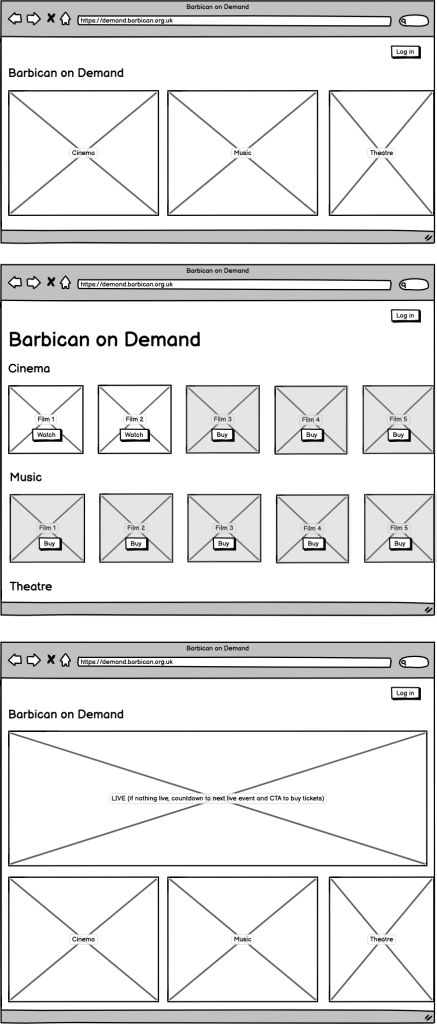
I used Balsamiq to create wireframes collating all of our favourite components into designs which we then voted on and took forward to development.
Shipping, learning, iterating
Due to the circumstances we conducted technical checks like load testing but limited user research prior to go-live. Instead we observed how people used our shipped product and iterated from there.
For example, I ran a series of A/B tests such as changing the copy on a primary CTA. One of these involving splitting traffic three ways, giving users A) the original button, or the choice to select either B) “Watch online” or C) “Online tickets”. The clear preference was “Watch online”, which generated twice as much income as either the original design or “Online tickets”.
We also added:
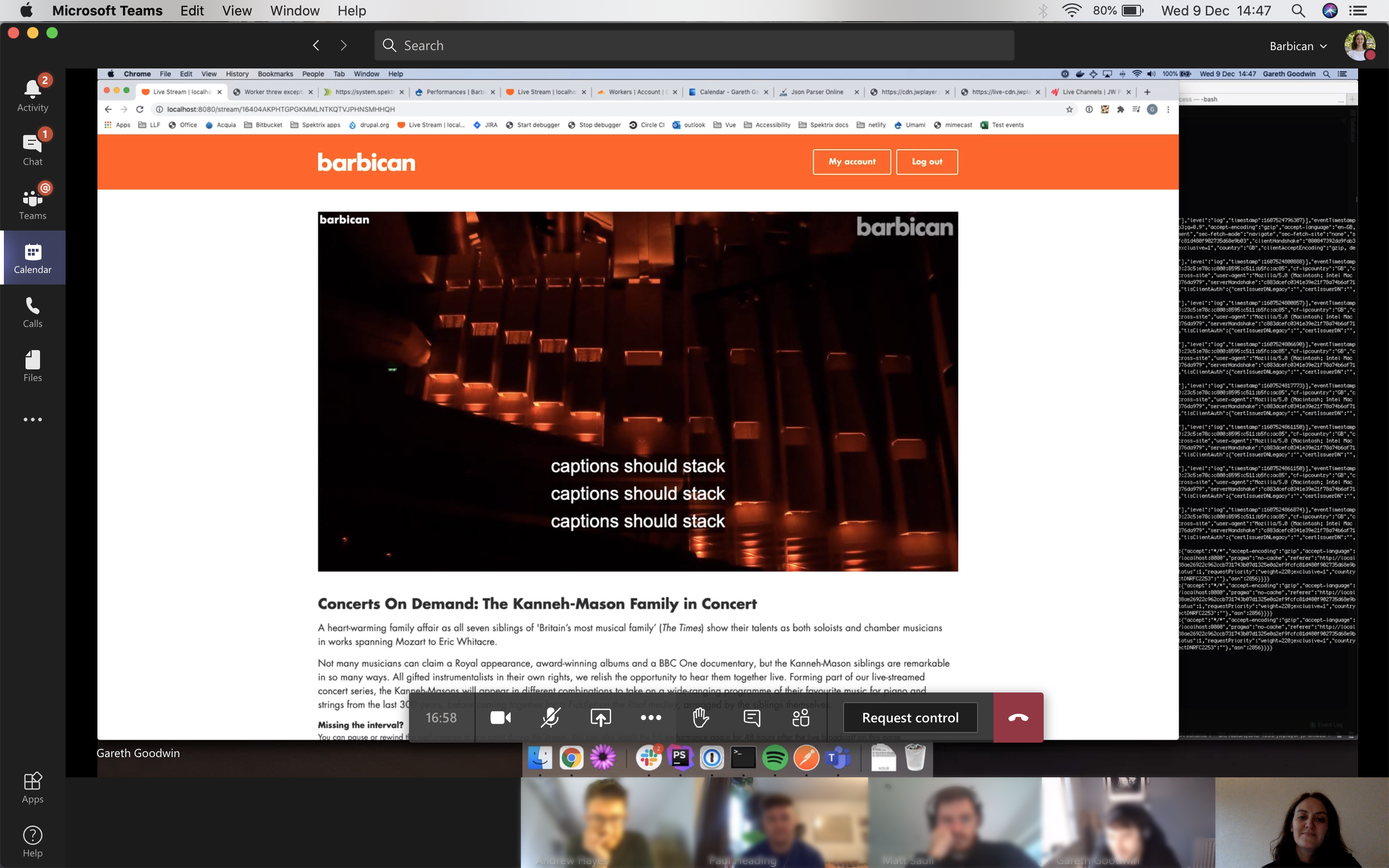
- Captions (to improve accessibility)
- A countdown to event start times (to encourage action per Parkinson’s Law)
- Live Chat (so that users could get instant help if they needed it)
As the Centre slowly reopened, we launched live-streaming with Live from the Barbican. This allowed users to watch our music events using a mobile, desktop, tablet, or smart TV. Performances were also available for purchase after the event, from a library of content.
Summary
While I always usually advocate for thorough user research, I remain incredibly proud of how our little team came together to deliver such an ambitious and important project so quickly.
The launches of Cinema on Demand (July 2020) and Live from the Barbican (September 2020) both made the news and were well-received by audiences/users and critics.
We continued to test, learn, and improve, such as increasing the length of time that purchases were available from 24 hours to 48 hours (based on user feedback).
Streaming was something that an art centre would almost certainly have considered at some point — but COVID-19 pushed us to do that quicker.
It also gave us opportunities: to better serve people with access needs and to reach a global audience.
Press coverage
What else have I done?
See more of my work, including Cancer Research UK’s Race for Life app and treatment access for patients at Bupa.
 Becky Colley, UX Designer